
IBS Anxiety: When Gut Symptoms Keep Your Body on Alert
You check where the bathroom is before you sit down.
You avoid eating before leaving home.
You calculate the traffic, the distance and how long you might be without access to a toilet.
You monitor every sensation in your stomach, wondering whether it is the beginning of another flare.
This is often what IBS anxiety looks like.
It is not simply “worrying too much.” It can become a constant mental and physical effort to prevent symptoms, avoid embarrassment and stay in control.
The gut symptoms are real. But when fear, anticipation and body scanning keep your system on alert, the gut–brain connection may also need support.
“IBS anxiety” is not about dismissing digestive symptoms as psychological. It is a way of describing the fear, anticipation and mental load that can develop around unpredictable gut symptoms.
IBS anxiety can quietly shape your whole day
For many people, the most difficult part of IBS is not only the pain, bloating, diarrhoea, constipation or urgency.
It is the uncertainty.
You may start asking yourself:
What if I suddenly need the bathroom?
What if I cannot leave the meeting?
What if I eat something and my stomach reacts?
What if I get stuck in traffic?
What if people notice?
What if I cannot cope?
These questions can begin before any symptoms appear.
You may wake up already checking your abdomen. You may avoid breakfast before a commute. You may choose the aisle seat, take a longer route because it has more bathrooms, or decline invitations because it feels safer to stay home.
These choices can make sense when you are trying to protect yourself. But over time, the nervous system may begin associating ordinary situations with threat or uncertainty.
Signs your gut may be keeping your body on alert
IBS anxiety may show up as:
checking for bathrooms wherever you go
avoiding traffic, public transport or unfamiliar places
eating less before leaving home
cancelling plans because your gut feels unpredictable
scanning your stomach for changes
feeling tense before work, travel, meetings or social events
carrying medication, spare clothing or “just in case” items everywhere
avoiding foods because you are afraid of a reaction
struggling to trust your body
feeling anxious when you are far from home
Not everyone will experience all of these patterns.
But when much of your day is organised around preventing a gut problem, your symptoms may be affecting more than digestion. They may be shaping your choices, confidence and sense of freedom.
The gut and brain are in constant communication
Your digestive system and brain communicate through the gut–brain connection.
This communication helps regulate digestion, sensitivity, movement, stress responses and your awareness of sensations inside the body.
When the gut has become sensitive or unpredictable, the brain may begin monitoring it more closely.
A small sensation can feel important.
A normal digestive movement can be interpreted as a warning.
The thought of being away from a bathroom can trigger tension before anything has actually happened.
This does not mean your symptoms are imaginary or “all in your head.”
It means the brain and gut may have learned to communicate with a high level of alarm.
The body can begin responding not only to symptoms, but also to the fear of symptoms.
The IBS anxiety loop
The pattern can look like this:
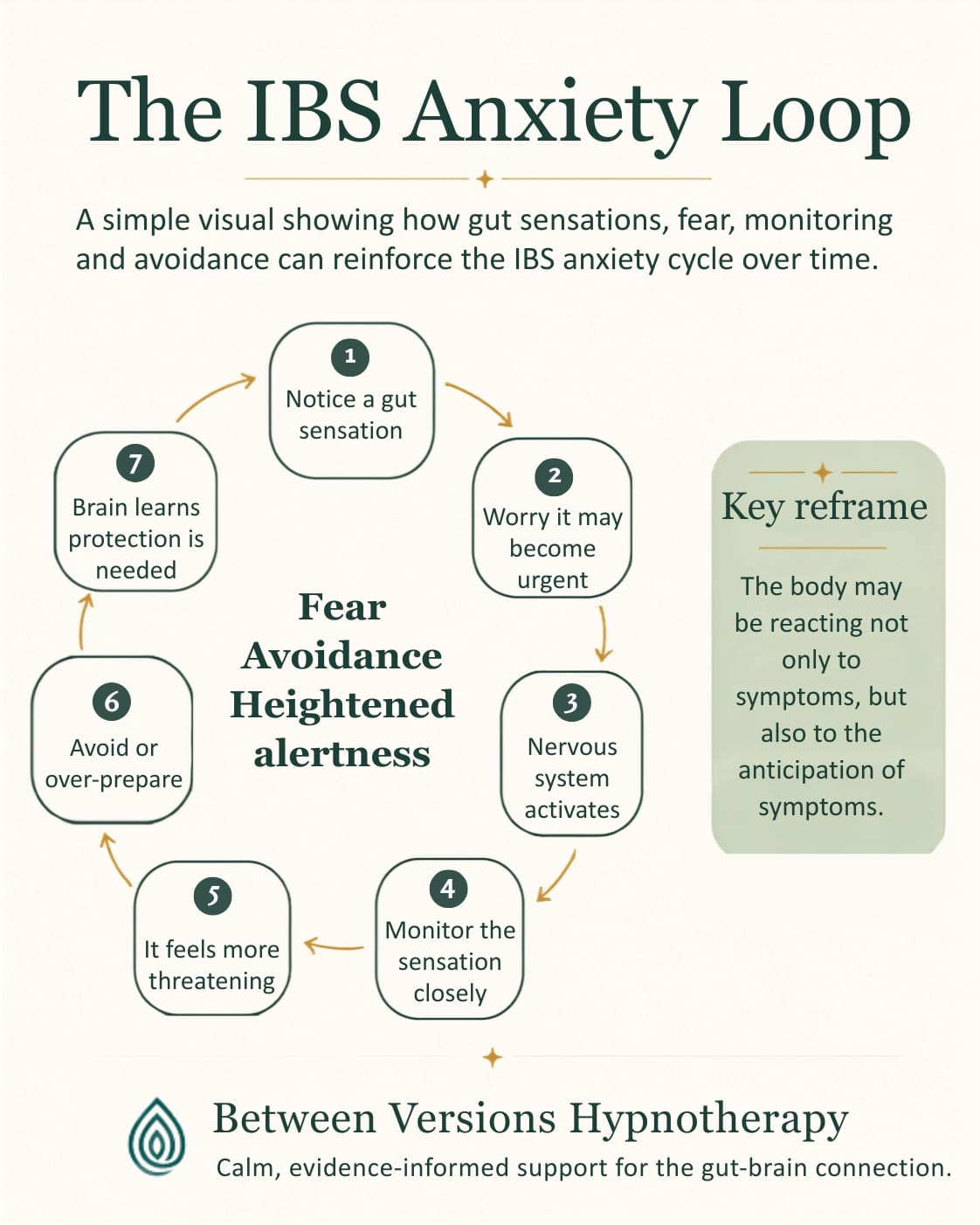
You notice a sensation in your gut.
You worry that it may become pain, urgency or bloating.
Your nervous system becomes more activated.
You monitor the sensation more closely.
The sensation feels louder or more threatening.
You avoid the situation or prepare extensively.
The brain learns that the situation required protection.
This loop is understandable. It is the body trying to keep you safe.
But when it happens repeatedly, it can become difficult to tell the difference between a genuine immediate problem and the anticipation of one.
Avoidance may help in the moment, but reduce confidence over time
Staying home, skipping food or checking every bathroom may provide short-term relief.
You feel safer because you have reduced the immediate risk.
But avoidance can sometimes strengthen the message that your body cannot cope without those precautions.
Over time, your world may become smaller.
You may stop travelling, attending events, eating with others or saying yes to opportunities.
You may become less confident in your ability to respond if symptoms occur.
The goal is not to force yourself into situations or ignore your body.
The goal is to help the nervous system respond with less alarm, so you can gradually rebuild trust and flexibility.
How Gut-Directed Hypnotherapy may support IBS anxiety
Gut-Directed Hypnotherapy is a structured, GI-focused approach that works with communication between the brain and the gut.
It is not simply generic relaxation.
The program uses gut-focused imagery, therapeutic suggestions and regular home audio practice designed to support:
calmer brain–gut communication
reduced symptom-related fear
less body scanning and hypervigilance
greater confidence in digestive sensations
a steadier response to anticipated triggers
improved trust in the body
At Between Versions Hypnotherapy, this work is offered as a structured six-session program, with weekly or fortnightly sessions and regular audio practice between appointments.
Daily practice is important because the aim is not only to feel calm during a session. It is to help the nervous system rehearse a different response consistently.
What progress might look like
Progress does not have to mean never noticing your gut again.
It may begin with smaller changes:
leaving home without repeatedly checking your stomach
eating before an appointment
sitting through a meeting with less monitoring
feeling more comfortable in traffic
attending a social event with fewer “just in case” preparations
responding to a sensation without immediately assuming the worst
recovering more calmly after a flare
trusting yourself to manage uncertainty
The goal is not perfect digestion or complete control.
It is a different relationship with your gut, your nervous system and the choices you make.
When medical assessment is important
Persistent, unexplained, new, severe or worsening digestive symptoms should be medically assessed.
Gut-Directed Hypnotherapy does not replace medical care, dietary support or other allied-health treatment. It may form part of a broader care plan for people whose symptoms are linked with stress, fear, sensitivity or learned gut–brain patterns.
Your life does not have to be organised around your gut
If bathroom checking, food avoidance, urgency fear or body scanning are shaping your day, you are not weak and you are not imagining the problem.
Your body may have become highly practised at anticipating danger.
With the right support, it may be possible to help the gut–brain system respond with more steadiness, flexibility and trust.
If your gut symptoms are shaping your choices, book a Gut Clarity Call.
Frequently Asked Questions
IBS anxiety describes the fear, anticipation and mental load that can develop around digestive symptoms. It may show up as checking for bathrooms, avoiding food before leaving home, cancelling plans, monitoring the abdomen or worrying about urgency, pain or bloating.
It does not mean the symptoms are imaginary. It means the fear of symptoms may also be affecting the nervous system and gut–brain connection.
Stress and anxiety can influence digestion, gut sensitivity and how strongly sensations are noticed. For some people, the nervous system becomes more alert to changes in the gut, which may make symptoms feel louder, more urgent or more threatening.
This does not mean anxiety is the only cause of IBS. It means stress and gut symptoms can sometimes reinforce each other.
Bathroom checking is often a protective behaviour. It can help you feel more prepared when symptoms have been unpredictable.
However, when it becomes necessary before every outing, meeting or journey, it may be a sign that fear of urgency is shaping your choices and reducing trust in your body.
Gut-Directed Hypnotherapy may support people whose digestive symptoms are linked with fear, body scanning, avoidance, urgency anxiety or nervous-system reactivity.
It is a structured, GI-focused approach that works with communication between the brain and gut. At Between Versions Hypnotherapy, the program includes weekly or fortnightly sessions and regular guided audio practice.
It does not replace medical, dietary or allied-health care.
No, a formal diagnosis is not always required before beginning Gut-Directed Hypnotherapy. However, we strongly recommend appropriate medical assessment, especially if your digestive symptoms are persistent, unexplained, new, severe or worsening.
Gut-Directed Hypnotherapy is designed to complement medical, dietary and allied-health care. It may be particularly relevant when stress, fear, symptom sensitivity or avoidance appear to be reinforcing the gut–brain pattern.
A useful question is:
“Are my gut symptoms changing where I go, what I eat or what I feel able to do?”
You may be affected if you regularly avoid travel, traffic, meetings, unfamiliar places, social events or food because you do not trust how your gut will respond.
Learn more about the gut–brain connection
What Is Gut-Directed Hypnotherapy for IBS?
Learn how this structured, GI-focused approach works and how it differs from general relaxation.Book a Gut Clarity Call
Explore whether this support may be suitable for you.
Book a Gut Clarity Call
If your gut symptoms are affecting what you eat, where you go, how you plan, or how much you trust your body, a Gut Clarity Call can help you explore whether the 6-Week Gut-Directed Hypnotherapy Program may be suitable.
This is a gentle first step to ask questions, understand the approach, and see whether this support is the right fit for you.
A short conversation to explore fit and next steps.

Vanessa Camelo
I’m Vanessa Camelo, founder of Between Versions and a clinical hypnotherapist with a grounded, structured approach to change.
My work focuses on helping people shift the patterns that keep them stuck mentally, emotionally, and physically — especially when those patterns continue even after they understand the issue logically.
I use hypnotherapy alongside practical tools to support nervous system regulation, subconscious pattern change, and more effective responses in everyday life. My approach is calm, evidence-informed, and tailored to the person in front of me rather than forced into a one-size-fits-all process.
I also have a particular interest in the gut–brain axis and gut-directed hypnotherapy, especially where stress, fear, urgency, anticipation, or nervous system reactivity are shaping the experience of symptoms over time.
Australia-based hypnotherapy for gut–brain symptoms, stress-related patterns, anxiety, and meaningful personal change.
This service does not replace medical, psychological, or dietary care where those are needed.
© 2025 Between Versions Hypnotherapy. All rights reserved.
Australia-based hypnotherapy for gut–brain symptoms, stress-related patterns, anxiety, and personal change.
This service does not replace medical, psychological, or dietary care where those are needed.
© 2025 Between Versions Hypnotherapy. All rights reserved.